The Low Country dance tradition, which originated in the lowlands and coastal areas of Sri Lanka, is a vibrant art form enriched with dance, singing, shanthikarmas, bali thovil, and yathikarmas rooted in folk life. It is widespread across coastal regions such as Galle, Matara, Kaluthara, Hambantota, and Colombo, and is divided into three main performance styles based on region – the Matara style, the Benthara style, and the Raigam Korala style. This regional distinction contributes to the diversity found within the Low Country dance tradition.
Low Country dancers are trained in a special room called the Ilangam Maduwa, where practice is conducted away from the public eye. A novice dancer first holds the Theikanda and begins by practicing foot movements known as pa saramba. Once the foot movements are mastered, hand movements are introduced, followed by the fundamental principles of the dance.
There are 32 Vannams in the Low Country tradition. They are known as Sindu Vannams. Although it is believed that most Vannams were composed during the Dambadeniya period, there is no written evidence confirming the origins of the Sindu Vannams, and thus their exact time of composition remains uncertain. It is said that these Sindu Vannams were inspired by Elu Sandas Lakuna.
The essence of the shanthikarmas in the Low Country dance tradition lies in seeking blessings for abundant harvests and their protection, good health, protection of environment and the safety of animals. Rituals such as Devol Madu, Gam Madu, Mal Madu, Gee Madu, Poona Madu, Dana Madu, Halluma Madu, Gini Madu, and Kolmura Yagaya are performed for deities, while Daha Ata Sanniya, Mahasona Samayama, Sooniyama (or Menikpala Shanthiya), Riddi Yagya, Kalu Kumara Samayama, Iramudun Samayama, and Kootaka Samayama are performed for demons. Bali Thovil and Graha Pooja rituals are performed for planets. According to tradition bearers, the Gam Madu Shanthikarma was first performed as Devol Maduwa in the Ruwanwella area as a preventive ritual. Since then, Gam Madu Shanthikarmas have become widespread across the Low Country, performed in colorful costumes that combine dance, music and singing.
Although the bead costume is the primary attire of the Low Country dance tradition, many different costumes are used depending on the gurukula (school of dance). These costumes are distinguished by their unique designs and splendour.
The Low Country drum is the main percussion instrument used in this dance tradition. It is also known by various names – Devol drum, Heiyan drum, Dethahari drum, Dik drum, Kinduru drum, Ruhunu drum, Wellakara drum, and Pana drum – depending on the type of dance, the shape of the drum, its use, and the sound it produces.
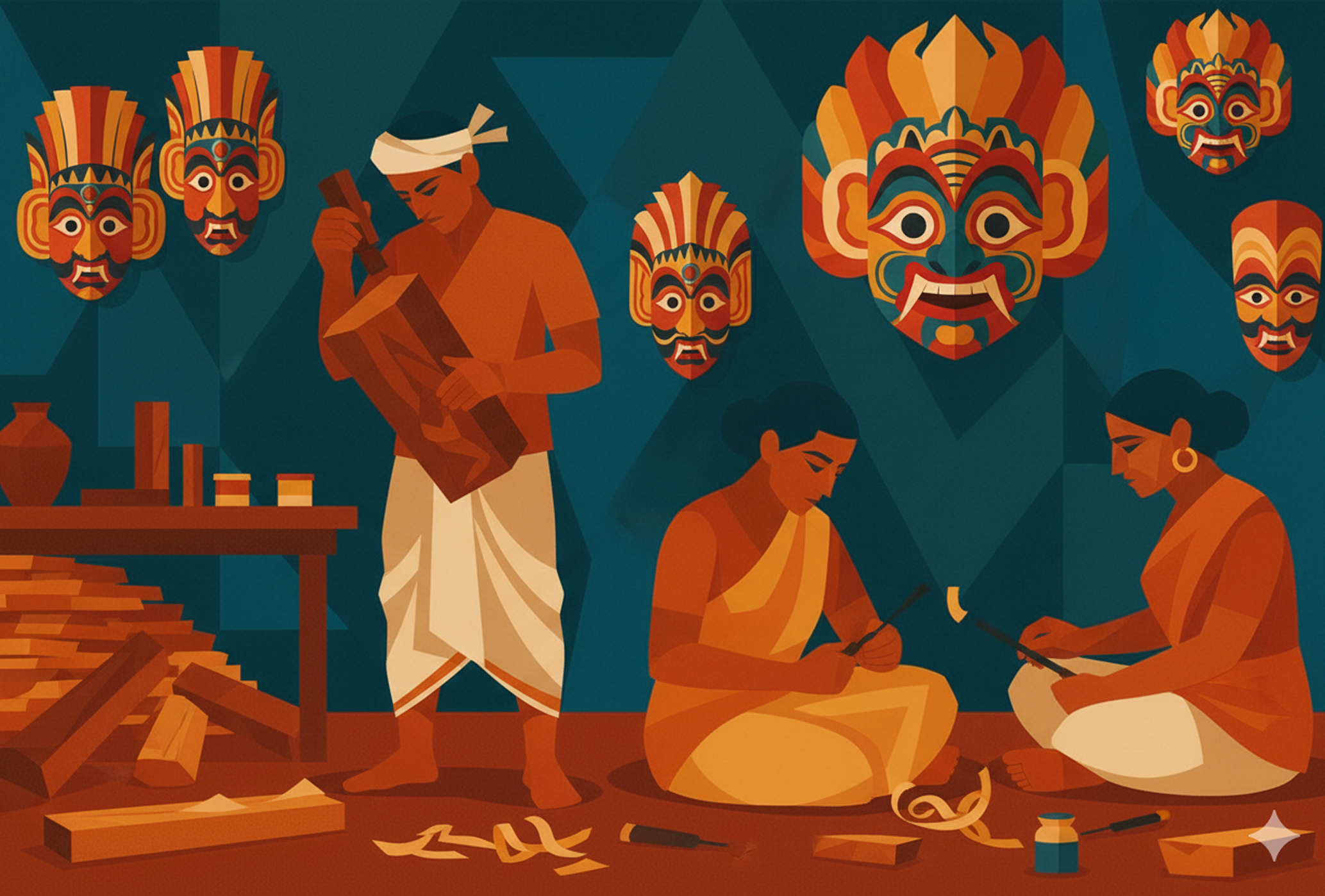
Masks are another distinctive feature of the Low Country dance tradition. The art of mask-making originated among the low-country communities. Kolam drama, which features performers wearing masks, holds a prominent place in this tradition. Historically, Kolam dramas served as a creative medium to satirize the weaknesses of the colonial regime.
Prominent figures who have rendered invaluable service to the development of the Low Country dance tradition include K. S. Fernando, S. H. Sawris Silva, Wilson Olaboduwa, Hadapangoda N. N. Sedaraman, and M. H. Gomis.
The Low Country dance tradition remains a remarkable and diverse art form that continues to embody the virtues of Sinhala culture through its rich heritage, vibrant expression, and deep connection to the lives of the Sinhalese people.